I’ve had some observations…
Old Journalism
Creation of news for publication used to be very hard. Typewriters could be obtained, but they produced documents that could be considered utilitarian at best, with no graphics, a lack of typeface options, and difficult situations if errors needed to be corrected. Then the 1980s happened: personal computers became affordable and desktop publishing software made it possible for the masses to create attractive newsletters and flyers.
 In the olden days, publishing news was hard. Production required large expensive printing presses. One person at home with a typewriter could write up a newsletter, but creating many copies of said newspaper required more resources than were feasible for the average Joe. Then the turn of the century rolled by and internet publishing became easier. Easy-to-use content management systems and blog platforms made it possible for the general public to easily spread news and other information online.
The industry of traditional journalism, with its controlled production and distribution, is dying as a result.
Old Stock Photography
Creating photos for stock sale used to be very hard. Professional camera and lighting equipment was expensive, and the incremental costs of film purchase and development made it important for a photographer to nail the perfect shot as quickly as possible. Then the 1990s happened, digital cameras dropped below $1000, and it was much easier for the masses to create a large quantity of photos of nearly every subject.
It used to be that the sale and distribution of stock photography was difficult. Photographers didn’t have an easy way to show their work to large numbers of the general public, so a few stock photography agencies would consolidate and market stock photos using a centralized model. Then the internet happened, and photographers were able to easily post and share their work online using mass-market photo sharing sites (such as Flickr) as well as personal photo gallery sites.
The industry of traditional stock photography, with its controlled production and distribution, is dying as a result.
Today’s Reality
In the reality of free market economics, industries rise and fall over time. New markets emerge and old markets fade away. If we speak in the terms of a life, traditional journalism and traditional stock photography are dying and are on life support. Unlike human life, the traditional stock photography and journalism markets will not be brought back to life. Computers are not just a fad; the internet isn’t some passing trend. We’re in a digital, connected world and the residents of that world have made it clear that they don’t want to buy newspapers and they won’t buy expensive stock photography.
There are individuals and organizations within the photography and journalism communities that have embraced the future and are diving headfirst into new ventures using their industry chops. There are also sizable crowds from each industry that are stuck in the middle, wanting to make the most of their traditional pasts and unsure of how to proceed into the new media world. Unfortunately, there’s a third set of folks, and they’re holding back each industry as a whole. I’m speaking of the folks that refuse to embrace the change and instead devote their energy to bitching about those who move forward.
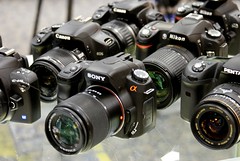 Deriding those who are using new models such as microstock or publishing local news on community-grown websites isn’t the answer. It’s rude, insulting, and distracting for those who are making a good-faith effort to move forward. I see similar negative rants coming from those in the stock photography market and those with a journalism background. I routinely come across pieces where a photographer posts sarcastic non-thanks for “more and more clients who don’t value good photography” and “more microstock crap to further devalue stock photography” or someone who compares journalism to brain surgery and advocates that citizens creating media can’t use the journalism word.
Your old stock photography and journalism model is dead. Please move on, or at least shut up and get out of the way of those of us who are.
The Future
While it’s not wise to ignore the past (something about being doomed to repeat mistakes), it’s similarly unwise to dwell there. Moving forward, journalists and photographers should look at what has worked. Investigative journalism won’t go away simply because old delivery mechanisms are obsolete. Well-lit, creative photography will still be in demand even with new distribution and payment models. We’re in the midst of exciting times with a lot of potential for future growth.
I’ve brought together the discussion of journalism and photography because there are so many similarities… not only in the downfall of tradition publication and distribution methods, but also in the opportunities for future growth. Smart journalists have embraced the web and social technologies. Bright photographers have figured out how to sell images outside of traditional stock channels. Having a blog doesn’t mean that one is practicing professional journalism, just as owning a camera doesn’t make one a professional photographer. Yes, “citizen journalists” and “citizen photographers” might take a small bit of the market once owned by “professionals”, but that doesn’t diminish the value that those who really know and understand the mechanics and business.
My predictions: photographers will adapt and embrace new licensing models that allow individuals or organizations to easily obtain licensing for photos in a system that’s easier for everyone involved. The best photographers will continue to stand above the rest, but easy payment and licensing options will mean that there won’t be a lot of future in the sale of images of everyday objects or scenes in everyday lighting. Journalists will embrace new delivery mechanisms for their work, with hyperlocal and realtime becoming the keys to an industry that was once focused on global and hours (or days) -old news.
While photographers and journalists with traditional skills and experience will have a leg up on newcomers, that past experience alone won’t guarantee one’s relevance in the next few years. Move forward. Do something different. Experiment. Risk. Those who are willing to take some risks and try new things are bound to become leaders in emerging markets. Instead of spending energy complaining about the past and the fact that things are changing, spend that energy learning something new, reaching out to a new audience, or experimenting with a new marketing technique.
Go make something interesting and new rather than living in a world dominated by sad reminiscence about days gone by.
This article is posted using open source blogging software and was illustrated using photos licensed under Creative Commons (from tiny_packages and The Suss-Man (Mike)).
Tagged as:
Business,
digital journalism,
journalism,
marketing,
new media,
old media,
stock photography,
stock photos
 I know I follow the blogs and photo websites of some of our regular commenters, but I know there are a lot of you who have websites and blogs and Twitter accounts that I might not know about.